Learn English Through History: Master the Past Simple
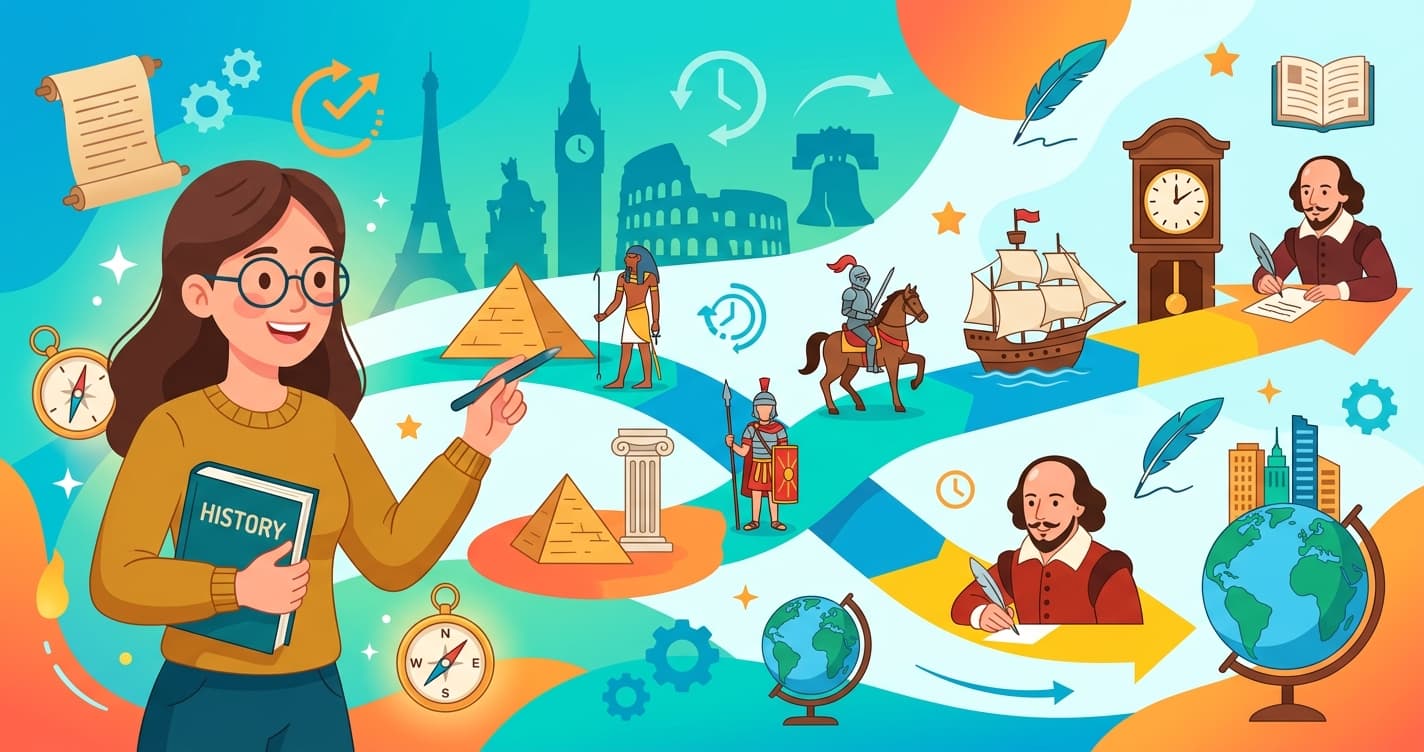
Welcome to the World of History
Do you enjoy learning about ancient times, brave explorers, and amazing inventions? History is full of exciting stories. But did you know that reading about history is also one of the best ways to learn English? When you read about the past, you naturally practice important grammar rules and learn new vocabulary.
At See Guru, we believe that learning English should be fun and interesting. Instead of reading boring grammar books, you can read about real people and real events. In this article, we will focus on one very important grammar rule: the Past Simple tense. We will explain it clearly using examples from history.
Why Learn English Through History?
Many English learners ask, "Why should I read about history?" Here are three great reasons:
- Interesting Stories: History is not just dates and numbers. It is about kings, queens, wars, and discoveries. It is like reading a great storybook!
- Context for Grammar: When you read history, you see the Past Simple tense everywhere. This helps your brain remember how to use it correctly.
- New Vocabulary: You will learn useful words that you can use in daily conversations, watching movies, or reading the news.
The Most Important Grammar Rule for History: The Past Simple Tense
If you want to talk about history, you must know how to use the Past Simple tense. We use the Past Simple to talk about actions or situations that started and finished in the past. Because history is all about finished events, the Past Simple is the perfect tense to use.
Let's look at how we build sentences in the Past Simple tense using historical facts.
Regular Verbs in the Past Simple
Regular verbs are the easiest to learn. To make a regular verb past tense, we usually just add -ed to the end of the word. If the word already ends in the letter "e", we just add -d.
- Invent → Invented: Alexander Graham Bell invented the telephone in 1876.
- Discover → Discovered: Howard Carter discovered the tomb of King Tutankhamun in 1922.
- Rule → Ruled: Queen Victoria ruled the British Empire for 63 years.
- Start → Started: World War I started in 1914.
As you can see, the action is completely finished. Queen Victoria is not ruling today, and the war is over. Therefore, we use the Past Simple.
Irregular Verbs in the Past Simple
Irregular verbs do not follow the "-ed" rule. You just have to memorize them. Many of the most common verbs in English are irregular. Let's look at some examples from history:
- Build → Built: The ancient Egyptians built the Great Pyramids thousands of years ago.
- Become → Became: George Washington became the first President of the United States.
- Go → Went: Neil Armstrong went to the moon in 1969.
- Win → Won: The Allied forces won World War II in 1945.
When you read history articles, write down the irregular verbs you find. This is a great way to memorize them!
The Verb "To Be" in History: Was and Were
We cannot talk about history without using the verb "to be". In the past tense, this verb has two forms: was and were. We use "was" for I, he, she, and it. We use "were" for you, we, and they.
- Albert Einstein was a brilliant scientist.
- The Maya people were excellent astronomers.
- It was very cold during the Ice Age.
- They were brave explorers who sailed across the ocean.
To make questions with the verb "to be", we just swap the subject and the verb. For example: "Was Albert Einstein a scientist?" To make it negative, we add "not": "They were not afraid."
Asking Questions About History
Sometimes you want to ask your teacher or friend a question about the past. To make a question in the Past Simple (for all verbs except "to be"), we use the helping verb "Did". The formula is: Did + Subject + Base Verb.
Notice that the main verb is in the base form (not the past tense form) because "Did" already shows that the question is about the past.
- Did the Romans build good roads? (Not: Did the Romans built)
- When did the Titanic sink?
- Did Christopher Columbus discover America?
Making Negative Sentences About the Past
If you want to say that something did not happen, you need to make a negative sentence. To do this, we use "did not" or the short form "didn't" before the base verb.
- People in the 18th century didn't have electricity.
- Dinosaurs did not live at the same time as humans.
- The Vikings didn't wear horned helmets in battle.
Again, notice that after "didn't", we use the base form of the verb (have, live, wear).
Practice Makes Perfect with See Guru
Reading about history is a fantastic start, but the best way to improve your English is by speaking. At See Guru, you can find professional English tutors for private, one-on-one online lessons. You can tell your tutor, "I want to practice the Past Simple tense by talking about history!"
Your tutor will correct your mistakes, help you pronounce difficult words, and give you confidence. Whether you are a beginner or an advanced learner, practicing with a real person is the fastest way to become fluent.
Frequently Asked Questions (FAQ)
Why is the Past Simple tense important for learning English?
The Past Simple tense is essential because it allows you to talk about your experiences, tell stories, and discuss historical events. It is one of the most frequently used tenses in daily English conversation. Without it, you cannot clearly explain things that happened yesterday, last year, or centuries ago.
How can I memorize irregular verbs easily?
The best way to memorize irregular verbs is to learn them in context. Instead of reading a long list, read stories or history articles. When you see a sentence like "The Romans built roads," you remember the connection between "Romans," "roads," and "built." Practicing with a tutor on See Guru also helps you remember them through speaking.
Can I learn English quickly by reading history?
Yes, reading history in English is highly effective. It improves your reading comprehension and expands your vocabulary. Because historical texts use the Past Simple tense repeatedly, you will naturally absorb the grammar rules without feeling like you are studying. To speed up your progress, combine reading with speaking practice.
Vocabulary
| English | Translation | Example |
|---|---|---|
| Ancient Belonging to the very distant past and no longer in existence. | Ancient | The ancient Greeks created the Olympic Games. |
| Century A period of 100 years. | Century | The 20th century saw many amazing technological changes. |
| Discover To find something or learn about something for the first time. | Discover | Scientists discovered a new dinosaur fossil in the desert. |
| Empire A large group of countries ruled by a single leader or government. | Empire | The Roman Empire was very powerful and covered many lands. |
| Invent To create or design a new object or process that did not exist before. | Invent | Thomas Edison helped invent the light bulb. |
| Leader A person who guides or directs a group of people or a country. | Leader | Nelson Mandela was a great leader who changed his country. |
| Explorer A person who travels to unknown places to learn about them. | Explorer | Marco Polo was a famous explorer who traveled to Asia. |
| Artifact An object made by a human being, often having historical interest. | Artifact | The museum displays many artifacts from ancient Egypt. |
| Civilization A human society with its own social organization and culture. | Civilization | The Aztec civilization lived in Mexico long ago. |
| Decade A period of ten years. | Decade | The 1990s was an interesting decade for popular music. |
| Tomb A large stone structure or underground room where someone is buried. | Tomb | The ancient king was buried in a beautiful tomb. |
Grammar Tip: The Past Simple Tense
We use the Past Simple to talk about completed actions in the past. It is the most important tense for talking about history!
- Regular Verbs: Add -ed (play → played). Example: They walked for days.
- Irregular Verbs: Must be memorized (go → went). Example: She wrote a famous book.
- Questions: Use Did + Base Verb. Example: Did he find the treasure?
- Negatives: Use didn't + Base Verb. Example: They didn't know the answer.
Ready to practice these words?
Book a private English lesson on See Guru and practice in real conversation!
Start Learning